
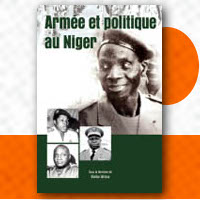
 How sad is it that I’m this excited about a book of history – polisci essays? How additionally sad is it that I’m trembling in terror over my girlfriend’s reaction that I just spent $40 on a whim?
Regardless, I’m very excited about finding a copy of “Army and Politics in Niger” (“Armee et politique au Niger”, actually) which was just published in 2008 by Codesria, but is already distributed in Europe and North America. Finding careful writing about contemporary Niger is difficult, and I’m usually sent off to local papers, Jeune Afrique, or the reference section to indulge my habit. I’d been looking for Kimba Idrissa’s “Niger: Etat et démocratie” for some time (with little luck), so imagine my joy at discovering this edited volume.
I can imagine few subjects as relevant to post independence Niger and its near future as its Army, the Forces Armées Nigeriennes (FAN). In a nation of 14 million where politics is a game played by maybe a million inhabitants of Niamey a half a dozen towns, the Army is as close to a defining institution of Nigerien nationhood as there is. The radio and Tele-Sahel may be close on the heels, but the fact remains that there have has been maybe one constitutional change of government in Niger’s history (the beginning of the Third Republic, when the Second dissolved itself) and there have been three changes of power by military coup. Something like 20 years since 1960 have been spent under direct army rule, by a force which today numbers well under 10,000. The short point is that there a lot of officers (and retired officers like the current President) who have felt it their duty to rule Niger without resort to republican niceties.
You should also ask the Tuaregs what they think of the Army. There’s been a level of impunity, noted by Amnesty and others, about killing civilians and their animals which wouldn’t make me want to share a home with some of the FAN’s officer class. And on top of that, the 1999 killing in a coup of the 1996 army coup leader/president has since revealed a degree of class and ideological factionalism within the ranks that would not induce me to hand these folks guns.
And while I’m bantering on this engaging topic, allow me to slip into the Cassandra mode I love so: The beardy weirdy Chief of Staff of the Armed Forces, Boureima Moumouni, will someday try to take power, and not in a nice, 1999 “shoot-the-leader-and-call-elections” way. He’s a cut from the same cloth as Seyni Kountché, who took power in 74 and had to drop dead before anyone could suggest even a constitution. And unlike Kountché, Boureima Moumouni doesn’t seem to have that barracks mentality where he’d rather live in a quonset hut than a palace. Just a heads up.
Anyway, the publishers extract is below. The introduction is downloadable from the Africanbookscollective.com. And you can read bits at google books.
- Kimba Idrissa (Ed.) Armee et politique au Niger. Codesria: Dakar (2008) ISBN 9782869782167
Niger’s political history has lacked a synthesis on the army’s involvement in politics since independence. The country is a fertile ground for such analysis. Between 1964 and 1999, the country witnessed three successful military coups during the democratisation process (April 1974, January 1996, and April 1999) and at least four military coup attempts (1964, 1975, 1976, 1983). In its forty years of independence, Niger has been under military rule for twenty-one years. It has also experienced seven different institutional regimes while four out of the six presidents who headed the country were soldiers. Niger evolved from the Second to the Fifth Republic in less than ten years – from the national conference (November 1991) to the last military coup (April 1999). In statistical terms, Niger has been witnessing a military coup or a military coup attempt every five-years since 1974. In addition to that, the country recorded seven mutinies and various other forms of troop rebellion between December 1963 and August 2000. In terms of institutional instability, Niger’s record is unparalleled in Africa. A study on the army is therefore more needed than ever before. The recurrence with which the military appears on the political scene imposes another way of looking at Niger’s army. A critical analysis of the military phenomenon, if not an assessment, would help envisage new prospects for Niger’s future. This work, which was undertaken by a multi disciplinary team, suggests an analysis, from a historical and sociological perspective, of the long-standing involvement of the army in politics (the apparition of war leaders in the 19th century, the transition from colonial army to national army,the politicisation of the army and the emergence of ‘military-politicians’, the army sociology.). It aims at providing an answer to a key question: Why is the army so deeply involved in politics in Niger? It reveals how a significant military component has been gradually built up in Niger’s political arena to become a highly dynamic political entrepreneur, able to compete with civilian politicians. The work shows, on the one hand, the significance of socio-political and economic contexts that promote the propensity for military interventionism, and on the other hand the transformations within the army that explain its propensity to intervene. It relates two decades of ‘military rule’, analyses their modes of legitimating, organising and managing power, gives an assessment of their economic policies and sheds light on women’s role in that institution, which was thus far a men’s business. This book attempts to provide a genuine biography of independent Niger. Given the quality of the contributions, this book is a reference tool for understanding Niger today, where the country comes from and where it is heading.