
Popular sound systems blend traditional sounds with DJ beats, and keep people across Bamako on their feet. But will Mali‘s capitol ban the “Balani Show” dance parties?
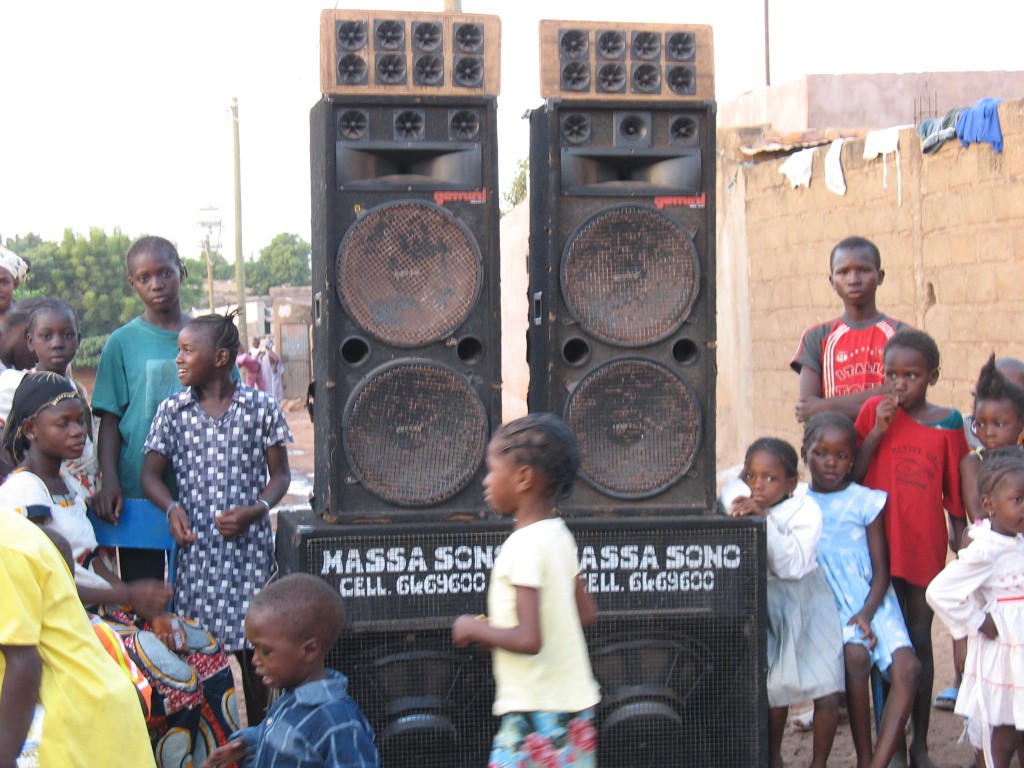
Current street corner culture in Bamako is dominated by the “Balani Show” dance party, a craze that crosses traditional Mande Balafon (xylophone) music with DJ’s, dancehall moves, sound systems, and dirty dancing. An Ivorian DJ named Dj Sénateur claims to have introduced the style in Mali around 2002, right in the midst of the outrageous dance music craze, the “Coupé-Décalé“.
In Bamako, “Balani Show” follows on the heels of another modernized traditional dance music craze, the Sabarni or Sa Bar Dance. Where “Balani Show” incorporates Balafon, Sabarni incorporated traditional Mandinka drumming. And like “Coupé-Décalé“, its the dancing that gets the attention. “Coupé-Décalé“, a blend of Ivorian pop and revived Congolese Rumba, is best known abroad for its outrageous dance moves. Its most famous were the Guantanamo, in which dancers paraded like handcuffed prisoners, and the “Bird Flu Dance“: launched in the midst of the Asian virus pandemic of 2007, where dancers strutted their stuff mimicking dying poultry.
Sabarni dances, circa 2002, were just as controversial, if less creative. Much bumping and grinding, in the way teenagers across the planet dance. All the rage at the discos, bars, and street corner parties of Bamako, scandalized religious leaders and politicians went so far as to convince the mayor to ban, on pain of law, the Sabarni. (Here’s a short movie from the time.)
Enter the the “Balani Show”. While elements of Balafon tinged pop have been called Balani for some time, the explosion of “Balani Show” in Bamako in the last five years has pushed DJs and mobile sound systems to the forefront. The city rumbles with dozens of street parties on holidays: one scandalized newspaper article claimed to have counted 96 across the city one holiday night this June. Other journalists complain that these parties breed mindless sex and violence, with “children” frequenting street parties armed with knives, guns, and tear gas canisters, on the prowl “as if at a football match” for other gangs or innocent passers by. Students are wasting their school breaks on this nonsense, journalists warn, and every special event from birthdays and marriages to national festivals, now requires a DJ and MC to lead dance contests backed by a deafening racket.
Of course, its nice to see that any society can have a moral panic, and whether its Mods and Rockers, “Gangsta Rap“, or Balani Dance, the worried “right thinking people” always seem to sound the same.
And it seems Bamako may have learned something from the Sabarni panic. Although the same concerned citizens are demanding their various city Communes ban Balani Dance parties outright, other leaders are trying to direct the concerns to stimulate young people to use the infrastructure of block party sound systems to tackle social ills and give them economic opportunities.
Moctar Sissoko, mayor of Dravéla Commune in Bamako is pushing to move loud block parties to the daytime, and help set up youth run initiatives to introduce social themes for the parties.
Better yet, the Projet Danbe (a Bambara word for Dignity) “Sound System Social” group was set up in 2008 to give young DJs and organizers a chance to acquire equipment and performance space. The next step in their plan is to set up youth run social centers, where locals could organize around issues of unemployment housing and education, with their Sound System tying it all together.
But I’m sure some people will still complain about the noise.
There’s been some academic interest in the subject. Anthropologist Craig Tower who has written a book about community radio in Koutiala, southern Mali, is due to present a paper called “Hard, Fast, and Loud: Balani Music, Mande Aesthetics and the Production of Minority Modernity in Mali” at a meeting in a few weeks.

The Dance Craze and Moral Panic in Bamako by T. Miles, unless otherwise expressly stated, is licensed under a Creative Commons Attribution-Share Alike 3.0 United States License.


![Reblog this post [with Zemanta]](http://img.zemanta.com/reblog_e.png?x-id=1ccccb30-21c1-4389-95e8-8bc7955af204)
With the miserable news from Japan taking a turn towards a science-fiction level of horror, I’m afraid I can’t get Mr. Burns of the Simpsons out of my head. In one episode, as his nuclear plant goes critical, Mr Burns is giving a phone interview to a local newscaster Kent Brockman, and happily lying [...]
Saturday the 12th of March will see second round voting in Niger’s Presidential elections, marking a return to civilian rule and the beginning of the Seventh Republic. It seems certain that front runner and PNDS-Tarayya candidate Mahamadou Issoufou will become the first President of the new republic on 8 April when the military junta that [...]
Here’s a fascinating new article on the history of Harlem activists A. Philip Randolph and Frank R. Crosswaith, and their involvement with the Socialist Party (riven by right and left factionalism) in the 1920s. It places them in contrast to Black Nationalism, but highlights the abuse they were willing to put up with at the [...]
As I write this, Saif Gaddafi is speaking to a Libyan people who have seemed to have already moved past his father’s regime. His late and desperate attempt to scare his countrymen into rejecting a revolution which has engulfed his nation touched one element with which, seemingly, those opposing him might agree. He blamed “crimes” [...]
The 31st of January saw Niger’s Legislative elections, combined with the first round of the Presidential elections. Results are not yet known, and the top two in the Presidential race will re-run on 14 March. Here’s some tools to follow it. The best immediate updates on the polls and count can be found at the [...]
As I’ll be spending most of this month tied to a TV or radio, I’ve so far noted one shocking fact: The South African World Cup is not riven by crime, corruption, shoddy workmanship, or terrorism. In fact, things are going swimmingly, the stadiums operations and infrastructure are beautiful, and the only deaths among the [...]
Hopefully by now everyone knows that parts of West Africa, especially pockets of Chad and Niger, are struggling with the worst food shortages since 2005. Alex Thurston reports that international humanitarian agencies, as well as increasingly concerned governments, are now worried that this crisis is more generalized than first reported (last September), striking areas of [...]
Jeune Afrique editor François Soudan has a biting new piece on the recent Togolese election. Noting defeated opposition candidate Jean-Pierre Fabre’s neologism “Africaneries” (for “African Inherited rule”, presumably) Soudan turns the tables of blame deftly. “For African oppositions, some of whom, in Guinea and Niger, have been reduced to military coups to break political deadlocks [...]
As I noted on the 10th of March, the CSRD junta in Niger has replaced all the civilian Region Governors with military men to administer local affairs during the transition. We now have the full list, and while I for one hate to see any military governing, a careful look at the men (all men) coming and going in Niger's Regions gives us an opportunity to examine what's going on behind the scenes, and what it augurs for the future.
More ...
The headlines from Lome, Togo are tension inducing. For Togolese or those with family there, it must be excruciating. It appears that President and dictator's son Fauré Gnassingbé has been elected, while the main opposition leader vowed struggle: “We will launch a popular uprising until victory is ours.”
More ...
Nigeriens were - are - undoubtedly pleased that the army stepped in to end a newly installed dictatorship. But criticisms of this so called "good coup" are beginning to appear even amongst its strongest supporters. With many months of transitional rule ahead, these whispers give us some idea of the problems the junta will soon face.
One doesn't see much film, let alone color film, of colonial era African football. So you can imagine my delight when I stumbled across clips of a French colonial propaganda newsreel featuring the my favorite African club side wining a colonial cup final from 1956. 
test
Thanks for the mention of my paper. I was surprised in my occasional self-googling to see this show up. I’d like to hear more about the balani panic in Bamako.
One thing to remember is that “balani” and “balani show” is primarily a southern Malian phenomenon, originating among the Senoufo, Minyanka, and Bobo peoples. They are all historically more animist than the Mande (Bamanan, Jula, Maninka) who predominate in Bamako and the central areas of Mali. Those southern Malians are perceived as less pious Mulsims in various ways (the hit single by Molobali Keita in 2006 was titled Tchimidjama, or “millet beer – not exactly appeasing to Muslim moralists in Mali). So, like most moral panics, the complaints attached to the noise and activity around balani shows might also be a complaint about the morality of those deemed be responsible.
They also like to play really loud, and a certain amount of distortion is viewed as aesthetically pleasing (there are small resonating pieces of leaves or papers attached to the resonators on the gourds underneath the keys of southern Malian balanis – not to be found on Mande bala!). So if the amps can’t handle it, it apparently doesn’t matter too much.
Thanks for the article and links.
On the historical predecessors of present day popular youth entertainments, one might refer to Meillassoux, Claude (1968): “Urbanization of an African Community. Voluntary Associations in Bamako. Seattle: U of Washington Press.” This wonderful book presents lots of detailed information on “dance crazes”and their institutional contexts in the 1960s (including “sabarnin”), and before.
One question: Who is the auther and what is the context of the nice film on sabarnin (sigi-kan)?
Best regards,
Rainer