
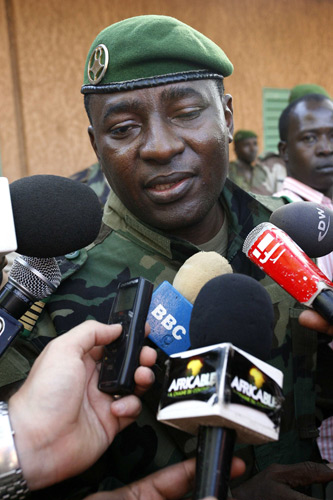
In a scrum of reporters Saturday, Col. Djibrilla “Pele” Hima Hamidou found himself on familiar ground. The voice of the 1999 coup leaders, Hima Hamidou read out all the statements in the days following 9 April 1999, appealing for calm and promising a speedy return to civilian rule. Last Saturday, following a meeting the leaders of the military “Conseil Suprême pour la Restauration de la Démocratie” with ECOWAS and UN officials, the armor commander and sometime football federation president again appealed for the world to trust the Nigerien military. “In 1999 we had a similar situation and we gave power back and we had 10 years of stability. We are going to do the same thing.”
The first extensive communique from the new CSRD junta in Niger was read out on local radio Monday night, and is now available in the state controlled newspaper, Le Sahel. It lays out in some detail the structure of Niger’s government during the period of military rule. If the junta is to be believed, and most Nigeriens do seem to believe them, the transition will be short. It explicitly takes as its model the Council for National Reconciliation (Conseil de Réconciliation Nationale CRN) of the 1999 coup against Ibrahim Baré Maïnassara, himself a coup leader who ended a constitutional crisis, but then decided to name himself President. After almost three years of protest, boycott, strike, and crisis, Nigerien armed forces took power on 9 April 1999. They quickly called a constitutional council and referendum which produced the 18 August 1999 Constitution of the Fifth Republic, and handed over to elected President Mamadou Tandja in December 1999.
Cmd. Daouda Mallam Wanke led the fourteen member CRN, which included several members from the current junta. The number two (or three, depending on your view) in the CSRD Col. Abdoulye Adamou Harouna was Wanke’s Aide-de-camp during the process. He’s now head of the elite ECOWAS fast reaction force, and was one of the most senior officers in the pre-coup army. One of his two brothers, all sons of a leader of the 1974 coup, is the senior paratroop officer who we saw hailed by crowds this Saturday. Appearing at an opposition rally at the Rond Point de Concentration in front of the National Assembly building on Saturday, Capt. Djibrilla Adamou Harouna promised a speedy end to military involvement. Captain Hima Hamidou from the CRN rose under Tandja to become a Colonel of the elite armored brigade and head of both the Army Football club (ASFAN), the Nigerien Football Federation, and now is near the summit of the CSRD. The heads of the eight “Zones de defense nationale”, the operational commanders of the military, all appear to be on board with the junta: Pele was head of the Niamey zone, the most important for obvious reasons. In the cases of Zinder and Agadez the Zone chiefs — invariably Colonels in a military with few Generals — seem to have directly supplanted the powerful regional governors of the former ruling party, the MNSD-Nassara. Although there is as yet to official list, other junta leaders include Colonel Ibrahim Wali Karingama, a former Fenifoot associate of Pele’s and a former head of the President’s security; General Abdou Kaza who until Thursday the Defense Adviser to President Tandja until yesterday. While the President of the CSRD, Cmdt.. Salou Djibo was a low profile officer in charge of the supply units in Niamey (and the heavy weapons store), Daouda Mallam Wanke was of the same rank on 8 April 1999. So some media reports that the junta is made up of “unknown” or “minor” officers are woefully inaccurate.
The second dubious assumption being made is that Niger, having had four coups in its history, is just experiencing its inevitable return to military “strongmen”. Niger has had more than its share of authoritarian rulers, both in and out of uniform. But in its more recent history, the military has shown an increasing reluctance to rule. Individual military men such as deposed chief of staff General Boureima spent much of the last ten years exercising considerable influence over the Nigerien government, but they did so behind the scenes, as part of patronage networks which led to the apex of the civilian state. The example of Baré Maïnassara, whose reign ended on 8 April in his brutal death, probably concentrated minds as well.
President Tandja, himself a Colonel who rose to State Security minister under the 1974 coup, reached his highest summit as one of the handful of political princes only after he retired. With him were a host of ex-military officers whose connections clearly paid off better out of uniform. Tandja’s eight month “Sixth Republic” might be best seen as the culmination of this politics, with elites personally tied to the head of state pushing out all other members of the political class. Any institutions which did not lead back to the President, in classic authoritarian form, were modified to do so after Tandja dismissed the opposition last June and wrote his own constitution last August. The fate former PM Hama Amadou, pushed out by his former mentor Tandja in 2007, can be seen as one more step in this process which had been going on for some time: the removal of networks of patronage other than those which culminated in President and his family (I’m thinking especially of Tandja’s wife Hadjia Laraba Tandja, whose activities we may hear much more about should her husband come to trial).
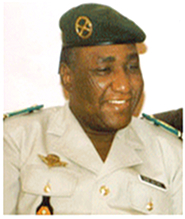
Cmd. Daouda Malam Wanké, 1999 as President of the CRN
In contrast to the muddle and confusion of the last year of civilian political crisis, the CRN junta’s coup of April 1999 was remarkable for its speed and continuity. I want to be careful here. Some observers, especially in Niger, have all but sainted Daouda Mallam Wanke as a selfless savior of democracy. The CRN had no qualms about suppressing dissent, closing down the press, and making sure they had a piece of the coming government. Junta number two General Boureima’s great power in the Tandja government dates from this period. But the most obvious example is the CRN’s non-negotiable demand that the 1999 constitution contain a clause granting blanket amnesty to the military for the events of the coup.
It is this provision, incidentally, which doomed the constitutional extension of Tandja’s mandate after the accepted two terms. A provision placed the basic structure of the executive, along with the military amnesty, under a clause which prevented any revision by any means. Hence Tandja did not, as reported by some, “revise” the constitution. He was not able to. He unilaterally terminated the constitution under powers which allowed the President to suspend it temporarily in times of emergencies such as invasions or civil wars, and then started a new one which better suited him.
But for all their faults, the CRN was never a naked grab for power. The former PM, Ibrahim Hassane Mayaki, was retained by the CRN throughout the transition, as were most ministers. In May, a month after the coup, the CRN had appointed a broad group of politicians and civil society leaders as a Technical Committee to sketch the outlines of a new constitution. The next month, they formed an 80 member civilian Constitutional Committee to write an actual text. When infighting ensued after the committee recommended the creation of hundreds of posts for politically connected individuals, the CRN stepped in and endorsed a draft that was closest to the Third Republic Constitution. The 1992 Constitution of the Third Republic was the result of the most democratic and open process in Niger’s modern history, the year long National Conference which followed a popular revolt against military rule. With this decided, a referendum approved the Constitution of the Fifth Republic in July and it was promulgated in August. The CRN had also re-formed the Independent Electoral Commission (CENI), a bedrock institution of the 1991-92 National Conference which had been fatally compromised by Ibrahim Baré Maïnassara following his 1996 coup. The 60 member CENI had members of all the political parties, including very small ones, and including those of the regime the CRN had just overthrown. In August, the CRN and the major candidates agreed to postpone the elections a month as parties reformed and wrangled over leadership. The presidential elections took place in two rounds on 17 October and 24 November, with parliamentary elections simultaneous with the second round. After Tandja’s victory in the second round, Wanke handed over the government on 23 December 1999.
So the 1999 experience, which the 2010 leaders say they wish to replicate, is one marked by continuity and reconciliation amongst the class of the the political elite. Nigeriens are watching today’s events with that template, and those expectations, in mind.
The contents of the first long communique on government structure, Monday’s “Communiqué du Secrétariat Général du gouvernement”, and the nominations of officials to go with it, conform to the 1999 model and flesh out the specifics of the CSRD regime. First the appointments.
The communique is not signed by a military officer, but by Larwana Ibrahim, as “Secrétaire Général du gouvernement”. Larwana was Adjunct Secretary General of Government — essentially the administrative director for the head of government — from 2000, and was moved into the top spot after the previous head, Lawal Kader, left office on the heels of deposed Prime Minister Hama Amadou in July 2007. Larwana Ibrahim, incidentally, signed the decree by Tandja Mamadou which dissolved the Parliament last June, setting off this crisis. Osmane Mahaman, named Director of the Cabinet of the President of the CSRD, was Administrative director of the last three PM’s of the Tandja regime: from the lukewarm Tandja-ist Seyni Oumarou, to the fiery loyalist (if temporary) PM Albadé Abouba, to the technocratic if corrupt Ali Badjo Gamatié.
Alkaly Alhassane is named as Assistant Director of the Cabinet of the President of the CSRD. Described in the release as a sociologist, he might be better know for having been “Conseiller spécial du Premier Ministre” under PM Hama Amadou in 2000 and having been DG of Niamey’s transit system (what there is of it), the Société des transports urbains Niamey, last year.

The actual communique sets out the government which will rule the nation during the as yet undefined transition period, in much the same terms as a constitutional document. Like the CRN, the CSRD is no democratic institution. It is formally run by the President of the CSRD, whose word is absolute, and whose right to appointment and rule is presumed. Perhaps troubling, the high courts, which Tandja dissolved and reconstituted as puppet institutions after June 2009, are again dissolved and named by the CSRD President. The junta acknowledges no check on its power. But this too is identical to 1999.
The reviled press board, the CSC, is also dissolved and replaced with the National Observatory of Communication (ONC), a name last used when the body was dissolved and reformed during the 1999 rule of the CRN. A once independent body with members chosen by press and civil society groups, the CSC has been transformed by Tandja into a press censorship board, as it had been under Baré Maïnassara. The names of the courts, and all the other institutions created in this decree are identical to those created by the CRN.
Finally, a body is created to draft a new constitution, as yet unnamed, which will then be approved or rejected by referendum. Again, identical to the 1999 process.
All this is not to say the the CSRD will actually abide by the process established in 1999. They have nearly absolute power and great popularity. But the opposition bodies that came out to celebrate this past Saturday in front of the National Assembly have released their own statements in the past days. The opposition front Coordination des Forces pour la Démocratie et la République (CFDR), as well as the civil society groups and trades unions within it, and the large and activist NGO coalition “RODADDHD”, have all made statements with the same theme. They thank and celebrate the CSRD, but demand that democratic rule must return quickly, completely, and transparently.
The junta says they share this vision, and if recent history is a guide, there will be a democratic government in Niger on 1 January 2011. But no one should yet take their eyes of what may be a difficult process for which the past may not fully prepare the people of Niger.
Notice of the General Secretariat of Government: President of CSRD signs two decrees.
The President of the Supreme Council for the Restoration of Democracy, Chef d’Escaudron SALOU DJIBO, yesterday signed two decrees making appointments. Thus, under the first decree, Mr. Ousmane Mahaman, Administrative Director, was appointed Chief of Staff to the President of the Supreme Council for the Restoration of Democracy.
– Finally, under the second decree, Mr. Alkaly Alhassane, sociologist, was appointed Chief of Staff Deputy Chairman of Supreme Council for the Restoration of Democracy.
COMMUNIQUE OF THE SECRETARIAT GENERAL OF GOVERNMENT
22 February 2010
The Head of State has signed a decree on the organization of government during the transition period
The President of the Supreme Council for the Restoration of Democracy, Chef d’Escaudron SALOU DJIBO, signed Monday, February 22, 2010, an order on the organization of government during the transition period.
Under this order:
The government of Niger is a republic. Being so, it reaffirms its commitment to the principles of the rule of law and pluralist democracy.
Recognizing its responsibility to the people of Niger, the Supreme Council for the Restoration of Democracy ensures the preservation of national unity and social cohesion.
It assures everyone equal before the law irrespective of sex, social origin, racial, ethnic or religious background.
It also guarantees the rights and freedoms of the individual and the citizen as defined by the Universal Declaration of Human Rights of 1948 and the African Charter on Human Rights and Societies of 1981.
It guarantees the restoration of the democratic process operated by the Nigerien people.
All rights and duties are retained conforming to the above the laws and regulations.
The government of Niger is and remains bound by international treaties and agreements previously signed and duly ratified.
The Supreme Council for the Restoration of Democracy (CSRD) is vested with legislative and executive powers until the establishment of new democratic institutions.
The Supreme Council for the Restoration of Democracy (CSRD) is the supreme arbiter of policy and direction of the nation.
It is headed by a President who serves as Head of State and Head of Government.
The President of the Supreme Council for the Restoration of Democracy (CSRD) by order appoints a Prime Minister and other members of the transitional government.
The President may end to their functions in the same manner.
The President of the Supreme Council for the Restoration of Democracy is the Chairman of the Council of Ministers.
He signs all orders and decrees.
He makes all civil and military appointments.
The President of the Supreme Council for the Restoration of Democracy may delegate certain powers to the Prime Minister.
The Prime Minister leads and coordinates government action in accordance with guidelines established by the Supreme Council for the Restoration of Democracy.
There shall be created, in place of the dissolved Supreme Court [Dissolved by Tandja after ruling against him last May, reconfigured as a Presidential appointed court], a State Court [Cour D’Etat] whose composition, powers and functions shall be determined by order of President of the Supreme Council for the Restoration of Democracy.
There shall be created, in place of the dissolved Constitutional Court [under the 5th Republic, an ad hoc body of senior legislators, reformed into a presidential appointed court last August], a Constitutional Committee whose composition, powers and functions shall be determined by order of President of the Supreme Council for the Restoration of Democracy.
There shall be created, in place of the dissolved High Council for Communication (CSC) [a once independent body, transformed by Tandja into a press censorship board], a National Observatory of Communication (ONC), whose composition, powers and functions shall be determined by order of President of the Supreme Council for the Restoration of Democracy.
There shall be created, under the authority of the President of the Supreme Council for the Restoration of Democracy, a body responsible for preparing the basic texts of the Republic, including the Constitution and the Electoral Code. The name, composition and powers of this body will be established by ordinance.
The above mentioned draft Constitution will be adopted by the Nigerien people by referendum.
Following a period to be determined by the Supreme Council for the Restoration of Democracy, this and other transitional institutions will establish new [permanant] democratic institutions.
A schedule of the various political deadlines will be made public by the Supreme Council for the Restoration of Democracy (CSRD).
Niamey, February 22, 2010
The Secretary General of Government
LARWANA IBRAHIM