
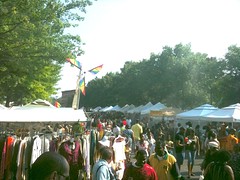
- Better choices for sunny afternoons: Outside the African Dance Fest in Brooklyn last week.
It’s beautiful in New York, and the world if full of things to argue about. Here are three important issues I’ll have to get back to you on.
While the world goes to hell in a handbasket, I have been trying to maintain my sanity with light reading, and sunny days on the back patio. This largely precludes the production of good (or even mediocre) writing. Further political catastrophes and World Cup drama could completely rule it out.
Despite that, there are several things which should appear here soon, plus a reading recommendation. Advice for further reading and different perspectives is always very welcome.
First, I’m working on a close reading of the latest US / West African drug arrests, this time focused on Liberia. Not to sound too paranoid, but these things never seem to hang together well when examined closely, and I’ve come to believe over the last few years that there is a commonality of interests between several right wing think tanks, a clutch of journalists and “terrorism experts”, UN Anti-Drug authorities, foreign governments, military, and local governments which play up the need for military and legal spectacle at the expense of actual work on development or ending corruption. While there is likely some real criminality going on in this case, I’m prepared to argue that this Liberian sting of aspiring West African drug runners serves more to allow these interests to further very specific political agendas.
Next, there are updates on the Nigerien political transition, with a new electoral law that has generated some controversy, while we wait for several party political and constitutional shoes to drop in Niamey (party leadership, coalitions, charges against Tandja supporters, not to mention and entirely new Constitution of the Seventh Republic that has to be written and voted on by the end of the year).
Most important to me, I’ve finally thoroughly read Dutch historian Baz Lecocq‘s 2002 dissertation, “That Desert is Our Country’: Tuareg rebellions and Competing Nationalisms in Contemporary Mali (1946-1996).” As it is available online, I had read later chapters when I’d seen it cited some time ago. But having stormed through from the start, I must say that it is the best thing written on the Malian Tuareg in English (easily) and arguably better than anything in French (to be fair, I’m thinking only of articles I’ve read by Georg Klute, the Bernuses, Claudot-Hawad, and Bourgeot. I haven’t read Pierre Boilley’s “Touaregs Kel Adagh”, let alone Georg Klute’s ”Die Rebellionen der Tuareg in Mali und Niger”, which I’ve only ever seen in German). With very few changes it could be produced as a very valuable book.
Lecocq’s basic premise – which he candidly admits was not the one he began with – is that French colonialism and the process of independence heightened a pre-existing “racial” prejudice between northern and southern communities in what is today Mali, even when outsiders might be unable to easily distinguish between these groups. Independence, as well as French and upper class Tuareg resistance to the form this independence, only deepened these divisions, reinforcing mistrust on all sides, keeping these communities at daggers drawn. This has played out through profound reordering in the structures and meanings of the notoriously complex and shifting Tuareg social/political order on one side. On the other, the brutality and hamfistedness of southern politicians and military has often exacerbated conflict, frustrating Malian society. Nine of ten Malian live in the south, and these communities, having paid dearly to create the imperfect economic development and political liberties they now enjoy, have little sympathy with Tuareg demands.
If you’re anglophone and interested in French colonialism in the Sahara, Mali’s first decades of independence, the current “Tuareg problem”, or even the more general history of cultural conflict along the interface of the Sahel, there’s tremendous value in this work. Admittedly, Lecocq really focuses on the history of “free” clans of Tuareg in (what is now) Kidal Region’s Adagh des Ifoughas, who make up only a portion of the population of even this limited area. But their politics and culture are central to the 1963, 1990, and 2006/7 rebellions, and all north south relations in Mali. Without understanding this, I’ve always found the causes of fighting there hard to understand, even in relation to the Nigerien Tuareg rebellions, which seem much more enmeshed in Niger’s politics and culture.
- Current preferred time waster: tommymiles on Twitter
