
 Two or three thoughts for the day. A review of Tom Goyens’ “Beer and Revolution: The German Anarchist Movement in New York City, 1880-1914.” is available. I may reprint it in full, as it’s under Creative Commons licensing. Allow me to digress (or not to, given the subject). Creative Commons is a Copyright/Left for creative works, which I think is generally superior to the GNU Public License. If you’re unaware of this, and you produce text, art, or photographs, you really owe it to the world to take a crash course. Copyright, which has expanded like a disease over the last fifty years, is doomed. In fact, it has expanded like antibodies fighting an overwhelming infection: proliferating in a failed attempt to smother its stronger foe. Information wants to be free, and all that.
But even with CC licenses you owe it to the rest of us to remember that the only thing you deserve from your work is the right to be identified as the person who created it, and recognized for exactly what you created. Try to impose a more strict license than that — which you can do in the CC — and it’s as doomed as copyright. It’s the intellectual equivalent of “those who don’t work don’t eat.” And since modern Capitalism is based upon one group of people benefiting from the work of other people, Copyright is going to go down fighting. Think “Terminator: Salvation”, but with less natural dialogue.
Second, I’ve been slightly obsessing about the papers recently: not the normal ones, but Niamey’s latest political crisis through the distorted mirror of the thriving newspapers of Niger‘s capital. Every day’s Le Sahel (the government rag), Republicain, Roue de l’Histoire, and Le Canard déchaîné are piped on line by two expatriate run websites, which means they probably have more readers abroad than they do at home (see below).
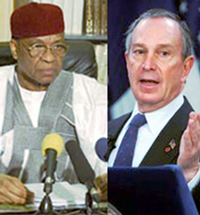
The President is attempting a slow motion coup, under the slogan “Tazartché”. My dictionary says that’s “continuity” in Hausa, but your results may vary. That a 71 year old ruler’s pals don’t like constitutional term limits (they want a refurendum on a New “Sixth Republic” before this November’s elections) is no surprise. One must give props to the writers of the 1999 constitution, though. Article 36 says that the President is limited to two Five year terms. Article 136 then says, that Article 36 (amongst others) is unrevisable. In any way. And yet President / Lieutenant Colonel Tandja and his MNSD party — created in 1987 as a single party modeled on Mussolini and Franco’s Integral Nationalist “managed” corporatism — want to pull an end run. Who in New York does this remind us of? Except in Niamey there is a vibrant opposition, massive protests, and an outside authority (ECOWAS) saying “changing the rules just before an election is a coup”.
As an aside, I’ve just learned that Mike Bloomberg is legally 5′ 6”, although he had previously pretended to be 5′ 7”, and even 5′ 1” on a drivers license. Isn’t that a felony? Additionally, anyone who’s stood near him thinks 5′ 6” is an exageration. Not that being short is bad, but being dishonest about it is a sign you might enjoy large cocaded hats and invading Austria.
So having established from obsessively reading the papers online (what a world), that Niger’s unstable political culture is more healthy than New York City‘s (Bloomberg is Mamadou Tandja, Anthony Wiener is Mahamadou Issoufou, Christine Quinn is Mahamane Ousmane, Reverend Billy is Moussa Kaka, I grow millet somewhere, etc…), what does this say about Nigerien politics? Still nothing good, I’m afraid. Headlines like “Ben Omar, le petit menteur!”, calling the Minister of Communications a liar, or impugning him with diverting catering funds as a University student in 1988, mask some simple facts.
Over %80 of Nigeriens are illiterate. Most don’t have access to clean water. Most live in rural communities and grow crops to feed their families, sell the excess when available, and travel for a few months after harvest doing odd jobs in Ghana or Nigeria to earn some cash. If the rains don’t come, there is little safety net. In part, this is poverty. In part this is because the intrusion of world markets since around 1980 (forced by the IMF and World Bank as “deregulation”) have turned rice and other basics into commodities, speculated upon by traders in London or Chicago, and consequently sold at prices matching what the Western Middle Classes can pay, but bought from government subsidized corporate agribusiness at prices much lower, and in volumes much higher, than any farmer can produce even in the poorest nations of the world. Given that reality, the newspapers slandering the largely ideologically vapid horsetrading that goes on amongst the Niamey elite is meaningless.
And that’s different from New York City only by degree, not by disease.
![Reblog this post [with Zemanta]](https://i0.wp.com/img.zemanta.com/reblog_e.png?w=560)
2 comments for “Don’t Write, Don’t Eat: Niamey, New York, and Copyright Capitalism”