
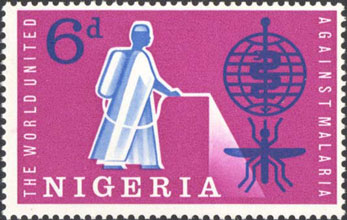
 I recently saw an appeal from US high school students, raising funds for anti-malarial bed nets to be delivered to the DRC. “When people find out they can donate $10 to save a life,” one Tampa Bay kid was quoted saying, “it really hits home, and they want to help.” The group is a “team” in the NBA / Sports Illustrated charity Nothing But Nets, which directs funding to Ted Turner’s UN Foundation along with several huge corporate charities supported by Exxon and other such entities. There’s no reason to believe that donations for bed nets go anywhere other than this project. And while other huge charities (like Oxfam) actually advocate for changing the world trade regime which cripples poor nations, but there’s no reason — if you have the money — why you shouldn’t donate to both.
Malaria kills a million people a year, mostly African children, but is preventable and treatable.
“Malaria is presently endemic in a broad band around the equator, in areas of the Americas, many parts of Asia, and much of Africa; however, it is in sub-Saharan Africa where 85 – 90% of malaria fatalities occur”1

Nations with year round endemic malaria (red)
Let’s be clear. Africa is NOT the only place where malaria is still endemic year round. Pretty much all of the tropics, and areas as far north as parts of Turkey, China, and Mexico see malaria year round. Other areas see it for parts of the year. People live in malaria endemic areas around the world. People get malaria in some of the most densely populated nations in the world, like Indonesia, India, and China. But 90% of the deaths are in Africa.

Cases of malaria (note the many places besides Africa)
Africa is just where most of the deaths are. Is this because people in other places all use bed nets? No, it’s because they have access to healthcare, clean water, have drained swamps near homes, and provided other measures which guarantee long lives.
If the United States and other powerful nations were to seriously deal with poverty, Malaria would cease to be a major threat. The lack of affordable medication, health care resources causes Malaria to be a killer in Africa. Niger, for instance, has just over 300 physicians for 14 million people, but pays tens of millions to the World Bank every year.
In fact, the entire government expenditure for Niger in 2002 was $320 million (in US dollars). By way of comparison the government of the ~ 8.5 million people of New York City have a $59.4 billion budget from 2009, described as an “austerity budget”. Re institution of the New York City sales tax on clothing (which I’d oppose: poor people would pay disproportionately) would bring in $350 million in 2010. The new Yankee Stadium cost $1.3 billion.
Nor is science alone the answer. One commentator noted, following the much hyped DNA coding of the Malaria virus in 2002, that HIV’s DNA had been know for a decade, but we were no closer to a vaccine. Now that malaria vaccines are in large scale trials, there’s no reason to believe that malaria will disappear from tropical Africa like it has largely done from the rest of the tropical world. Children still die of Measles, in outbreaks in Niger in particular. There are vaccines, many children get them, but children forced to follow their families on seasonal migration seeking work or grazing land often miss their boosters. And there are no clinics in most rural areas to administer them.
In 1900, there were malarial swamps across the US south, around Chicago, in the suburbs of Rome. In 1882, Malaria was endemic in half the United States.
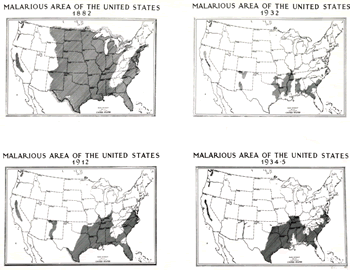
“Malaria’s decline in the United States and Europe in the late 1800s was due mainly to draining swamps and removing mill ponds. Draining swamps also exposed good agricultural land, enabling people to afford better houses and thus isolate the sick. Increasing livestock densities may have diverted biting from humans toward cattle, pigs, or horses. Improved housing, isolation of sick people in mosquito-proof areas, better access to health care and medication, and improved nutrition, sanitation, and hygiene all may have reduced transmission and/or mortality rates.” 2


The United States Malaria eradication campaign: Aircraft spraying from the 1920s, DDT advert from the 1940s
So its very clear what the answer is. If westerners are dying, we should invest in health care and infrastructure, drain swamps, and spray everything that moves with DDT.

The solution offered Africa: Seydou Keita hands out donated nets in Mali
If Africans are dying at the rate of 3000 a day, we should give out bed nets, and send celebrities to “teach them” things. Again, don’t get me wrong. Those bed nets will save lives right now, and they are desperately needed. But if they are the only answer we give, then we are handing Africans out to dry. Again.
Bed nets are not the reason millions of white people don’t die from malaria right now. Doctors, swamp draining, closed sewers, DDT, schools with free vaccination regimens are. Hell, even paved highways, allowing easy transport of medical and construction resources are crucial. It’s not that sub-Saharan Africa lacks bed netting: its that it lacks all these other things. And it lacks these because it is poor. We can go into why that is, but suffice to say its not going to reflect well upon colonialism, dictators propped up by foreign powers, subsidized dumping of Western agricultural products or other goods, Structural Adjustment programs, etc. Malaria vaccines exist now, treatments exist, malarial habitat eradication exists. African’s die because of their poverty and our profits, not lack of bed nets.
See also:
- Link: Why capitalism isn’t really fighting malaria: Phil Ward
- Link: AntiMalaria day in Mali
- Link: The Great Failure of Malaria Control in Africa: A District Perspective from Burkina Faso
- Link: Africa: Broken Promises on Malaria, 12/13/02
- Link: The billion-dollar malaria moment. Mark Grabowsky Nature 451, 1051-1052 (28 February 2008)
- Link: http://www.malariasite.com/
- Link: BEDNETS FOR MALARIA CONTROL April 4, 1996. International Development Research Centre
- Link: Katrin Gaardbo Kuhn, Diarmid H. Campbell-Lendrum, Ben Armstrong, and Clive R. Davies. Malaria in Britain: Past, present, and future. Proc Natl Acad Sci U S A. 2003 August 19; 100(17): 9997–10001.
- And finally, the wonderful Bad Air: Malaria in Africa Blog, with links and art from 2006.
![Reblog this post [with Zemanta]](https://i0.wp.com/img.zemanta.com/reblog_e.png?w=560)
1 comment for “Needed Bandaids for Malaria”