
Guinea: Bloody Repression Marks Independence

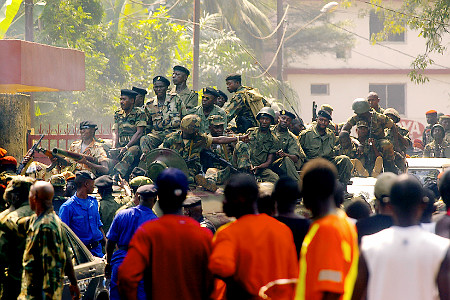
Troops roll in to Conarky 28 Dec. 2008Reports have been coming in all day of a mounting death toll among anti-Junta protesters in Conakry, Guinea.

The cadre of young officers around Moussa Dadis Camara, whose December 2008 coup raised expectations of the first real change in Guinea’s authoritarian kleptocracy since 1984, instead quickly reverted to type.  The oppression of opponents and journalists, groups initially invited to consult with the CNDD coup government on a return to democracy and pluralism, are now victims of brutal and continual repression by the military and their civilian allies. Dadis Camara, reversing his original pledges, seems certain to run in the January 2010 Presidential elections, while mining interests and corrupt officials, at first purged from the military/technocrat government, are again in the drivers seat.

The bloody events of this September 28th — the 51st anniversary of Guinea’s rejection of union with France and its demand for independence — seem a continuation, even an escalation, of the force used to crush the January-February 2007 general strike. Today opposition and labor protesters descended from the main boulevards of the city to the national stadium (“Stade du 28 Septembre”), but were met with a ban order, lines of troops, live fire, and rumors that the military is disappearing captives and bodies of the dead. As many as 80 bodies have been rumored to have been laid out in the stadium itself.  If anything like the events of 2007 reoccur, the military would be willing to continue this crackdown for weeks or even months.

There are also reports that opposition organizers Cellou Dalein Diallo, Jean-Marie Doré Sidya Touré, and leaders of the RPG party and the UFDG trade union were arrested and/or injured.

This follows the general strike in Labé on the weekend, when Dadis Camara’s new party the Rally for Defence of the Republic (RDR) chose the opposition stronghold and capital of the ethnically Peul/Fulani dominated Fouta Djallon highlands to unofficially launch his presidential campaign. A 20,000 strong protest march and general strike by the citizens of the area followed. In the midst of the violence in Conakry, there were reports that other regional centers saw protests brutally repressed.

Who can say what will happen: Conakry has seem abandoned by the world for more than a decade, since drought ground the massive hydroelectric plant in the north to a halt, throwing the city into darkness.  Funds were never forthcoming to fix this Western backed white elephant, and so the infrastructure built around it decayed in place, with street lamps, homes, road, sanitation, and security collapsing on top. The increasingly brutal government of 1984 coup leader Lansana Conte tore through A Second Republic, and then a Third, with no real democracy on offer. The influx of refugees in the 1990s from Liberia, Sierra Leone, and later Cote d’Ivoire has pushed Guineans to the limit.

Now sanctions have followed the Coup, and Guinean’s suffering mounts. A Burkinabe columnist for L’Observateur Paalga wrote a week ago that “For a country that is among the poorest in the world and lives through grants from funding partners, are these the people who will pay the cost of the vile ambition of one man?”

A wild card here is the seemingly unwavering support Senegalese octogenarian President Abdoulaye Wade has had for the Junta, even in the face of AU sanctions, Dadis Camara’s reversal on his pledges to see a democratic transition, show trials of (still likely corrupt) former officials, and random violence by military of all ranks.  Expat Guinean opposition activists in Paris and New York have targeted Wade’s involvement in protests over the last month, and the Senegalese opposition have been quick to tie Wade’s support for dictatorship abroad with his continual promotion of his inexperienced son Karim into higher power and his announcement that after more than a decade in power and nearing 90, he will stand again in the next Senegalese presidential elections.

From such dirty dealing comes all sorts of unintended horrors.  Also last week, there were reports of xenophobic attacks on Senegalese living in Conakry in retribution for Wade’s role in supporting the Junta.  And Guineans in Senegal are beginning to fear they too might be targeted.

From a wider view, Dadis Camara’s behavior is one more in a tide of rising semi-dictatorships happening across West Africa.  Two decades ago, the wave of democratization across the region set a thousand polisci students scribbling about a dawning of democratic institutions in West Africa.  2009-2010 may be the final collapse of that bubble.  Nigerian academic and columnist Jibrin Ibrahim‘s September 27th piece titled “Dramatic reversals” is a sad accounting of this process, from Niamey to Abidjan, to Bissau, Banjul, even Dakar and Conakry.  He writes:

Presidents Jammeh of the Gambia and Wade of Senegal have arrogated to themselves the right to rule for ever. Presidents Tandja of Niger and Wade of Senegal are grooming their sons to take over from them. Blaise Compaore of Burkina has no son so he is grooming his brother to take over. To achieve their objectives, these presidents are dismantling the constitutional order of their countries.

In Niger, President Mamadou Tandja organised a constitutional ‘coup d’état‘ violating the Nigerien Constitution and the fundamental instruments of ECOWAS and the African Union (AU). He dissolved Parliament and the Constitutional Court for daring to challenge his reckless ambition.

In Guinea, Captain Moussa Dadis Camara is poised to fail to honour commitments he freely made not to be a candidate in the elections to be held in January 2010. He has been paying rented crowds to call on him to contest for the presidency. While we were in Accra, two of his colleagues, Sirleaf Johnson of Liberia and Abdoulaye Wade of Senegal visited Conakry and joined the rented crowd in supporting the ambition of the putschist to remain in power.

Meanwhile, numerous human rights violations are occurring in Niger and in Guinea as the two leaders are arresting leading opposition elements and human rights activists. The International community under the leadership of ECOWAS has been putting pressure on President Mamadou Tandja of Niger and Captain Moussa Dadis Camara in Guinea to refrain from their political adventurism and the reversal of democratic gains in their countries so that West Africa does not return to the era of violent political conflict.

Paradoxically, Nigeria’s role in contesting the erosion of democracy in the region has been very positive.

Well, you can read the rest, but let us add the recent elections in Gabon, Congo-Brazzaville and Mauritania to the list.  There is no secret here.  There’s money to made; western and Chinese gold, uranium, oil, and gas firms are in the midst of a scramble for contracts across the region.  Mali announced last week the first oil prospecting parcels covering the desert northeast Kidal Region were being auctioned off, in a place until recently in the midst of rebellion.  The rumor in Niamey clearly holds for across the region: why leave just as we’re starting to cash in?

That Nigeria and Ghana are seeming exceptions may be explained in part through events like Obama’s endorsement of Accra’s business climate and the shocking crack down on millionaire Nigerian bank borrowers in arrears to failing banks.  Resource extraction and rentier states are the longstanding way in which West Africa has fit into global capitalism.  Lagos and Accra, though, are at the center of other changes, of deepening capitalist transformation.  In Nigeria in particular there is enough of a business class, bolsters by kleptocracy over the last thirty years, that real live domestic capital accumulation is happening.  There and in Ghana — not accidentally both anglophone — are becoming the jumping off points for foreign penetration of Africa.  From here foreign firms are tumbling over one another to secure African states farther afield as sources of raw materials.   But in the process, these forces, especially those from Asia, also are beginning the capturing of African markets themselves.  The explosion of cheap Chinese motorbikes across Bamako or Western, Arab, and Asian telecom setting up shop in Accra; these are signs of a extension of world markets into West Africa as never before.

What’s happening in Conakry, as in many African capitals, is a battle for who will sign these contracts on the African side, and get very rich in the process.  In Guinea, as recently in Niger and Gabon, some Africans are fighting this process.  But they appear to be losing.

Some useful sources for keeping up with events in Conakry. Note that on the 28th, both Guinean news  sites were getting periodic errors as their servers were overloading.  Please hold off on hitting them too hard if you can:

Reblog this post [with Zemanta]

4 Comments Post a Comment
  1. Tommy says:

    test

  2. Tommy says:

    test 2

  3. Tommy says:

    test 3

  4. Bob Smith says:

    Test 4

Leave a Reply


Past Features

  • “Unrequested fission surplus”: Kent Brockman, meet Jay Lehr
    15 March 2011 | 5:33 pm

      With the miserable news from Japan taking a turn towards a science-fiction level of horror, I’m afraid I can’t get Mr. Burns of the Simpsons out of my head. In one episode, as his nuclear plant goes critical, Mr Burns is giving a phone interview to a local newscaster Kent Brockman, and happily lying [...]

  • Niger: Lucky Seven. Can a new president signal more responsive politics in Niamey?
    11 March 2011 | 3:02 pm

    Saturday the 12th of March will see second round voting in Niger’s Presidential elections, marking a return to civilian rule and the beginning of the Seventh Republic.  It seems certain that front runner and PNDS-Tarayya candidate Mahamadou Issoufou will become the first President of the new republic on 8 April when the military junta that [...]

  • An Echo of New York’s Unfinished Struggles: A. Philip Randolph, Frank Crosswaith and the Socialist Party
    4 March 2011 | 3:14 pm

    Here’s a fascinating new article on the history of Harlem activists A. Philip Randolph and Frank R. Crosswaith, and their involvement with the Socialist Party (riven by right and left factionalism) in the 1920s. It places them in contrast to Black Nationalism, but highlights the abuse they were willing to put up with at the [...]

  • Libya’s “African Mercenary” Problem
    20 February 2011 | 11:07 pm

    As I write this, Saif Gaddafi is speaking to a Libyan people who have seemed to have already moved past his father’s regime.  His late and desperate attempt to scare his countrymen into rejecting a revolution which has engulfed his nation touched one element with which, seemingly, those opposing him might agree.  He blamed “crimes” [...]

  • Niger’s Presidential Elections are Underway
    1 February 2011 | 5:09 pm

    The 31st of January saw Niger’s Legislative elections, combined with the first round of the Presidential elections. Results are not yet known, and the top two in the Presidential race will re-run on 14 March. Here’s some tools to follow it. The best immediate updates on the polls and count can be found at the [...]

  • A Cairo Revolution
    29 January 2011 | 7:07 pm

    Marching in Imbaba, Cairo, originally uploaded by RamyRaoof. One overlooked media revelations from the Arab Revolutions of 2011 is the amount of material released with reusable copyright. Ramy Raoof in Cairo is releasing his work with a CC Attribution license, meaning popular media, as well as outlets like Wikipedia, have access to images of these [...]

  • Shock! South Africa WC not a tourist killing orgy.
    17 June 2010 | 4:29 pm

    As I’ll be spending most of this month tied to a TV or radio, I’ve so far noted one shocking fact: The South African World Cup is not riven by crime, corruption, shoddy workmanship, or terrorism. In fact, things are going swimmingly, the stadiums operations and infrastructure are beautiful, and the only deaths among the [...]

  • Niger, Mali: Hunger, famine or both
    27 May 2010 | 7:23 pm

    Hopefully by now everyone knows that parts of West Africa, especially pockets of Chad and Niger, are struggling with the worst food shortages since 2005. Alex Thurston reports that international humanitarian agencies, as well as increasingly concerned governments, are now worried that this crisis is more generalized than first reported (last September), striking areas of [...]

  • Niger: Innovative reforms amid famine
    25 May 2010 | 4:14 pm

    From 2005: “Drought has turned farmland into useless dirt…” Image via Wikipedia An unsigned editorial from Le Pays (Ouagadougou): A quite good reflection on the educational and other restrictions coming for future governments in Niger, but tying the famine. The papers in Niamey have little mention of the small farmers and herders Tahoua, Tillaberi, Diffa, [...]

  • Niger: Another kidnap in the north
    22 April 2010 | 3:22 pm

    The French press is reporting that a French tourist and an Algerian guide were kidnapped by armed men today in northern Niger, near the well at In-Abangaret. Also spelled Inabangaret, it's a stopping place on the Azzouagh plain's Tahoua/Assamakka/Tamanrasset road. This puts it relatively near the attack of several months ago on the Tahoua/Tillia road, and within reach of the band that carried out the attack on a Tillaberi army post last month. They were traced as far as the hills of west of Tin-Essako in Mali's northern Gao Region. While In-Abangaret doesn't come up in the news much, it is an important seasonal gathering point for some Tuareg communities (there is a "In-Abangaret Cross" in the famed Tuareg armorial tradition), as well as being in the midst a Berabiche transhumance zone. A hand grenade attack on Algerian truckers there in 1997 caused concern, with former members of one of the Arab rebel factions blamed for running a protection racket against long haul transport.

  • AQIM: More hostage stories
    20 April 2010 | 7:33 pm

    Philomène Kaboré and her husband Sergio Cicala have given interviews regarding their captivity: she having been released some time ago, and he Friday the 16th. They were taken in Mauritania, near the border with Mali, on...

  • Mali: Creeping famine in the north
    5 April 2010 | 3:35 pm

    Issikta blog republishes an urgent appeal from the mayors of Adielhoc and Tinzawaten communes in Kidal Region, northeast Mali. In a land where seasonally migrating animal herds are the economic foundation, there are reports of %40 of herds starving for...

  • Music: Early Ambassadeurs du Motel with Salif Keita
    22 March 2010 | 1:25 pm

    The Worldservice blog features tracks by Salif Keita & Les Ambassadeurs du Motel, from the first years after he left the Rail Band. I never knew there were such hard feelings. He quotes Salif Keita: "With the Rail Band I learned nothing, we only played what we heard. Les Ambassadeurs were more experienced: we weren't playing modernised folklore. Les Elephants Noirs were intellectuals. Arriving at the group I signed an apprenticeship contract to study music. We really played all kinds of music. We were like a real family, I really felt more at ease with Les Ambassadeurs. We rehearsed and studied the songs from 10 a.m. to 2 p.m. and played them the same evening."

    As always, the Dutch DJ behind "WrldServ" provides background you'll find few other places, as well as rare tracks, and in this case, rarer video. Check it out.

  • AQIM: Reports of the travels of the Tiloa attackers
    17 March 2010 | 10:11 pm

    Jeune Afrique reports sightings of the AQIM men who attacked the Nigerien army post at Tiloa, in the far north of Tillaberi last week. Apparently the Army knew there was a chance of attack somewhere in the area, having asked for reinforcements two days...

  • Togo: the political class fails its people, again.
    15 March 2010 | 3:01 pm

    Jeune Afrique editor François Soudan has a biting new piece on the recent Togolese election. Noting defeated opposition candidate Jean-Pierre Fabre’s neologism “Africaneries” (for “African Inherited rule”, presumably) Soudan turns the tables of blame deftly. “For African oppositions, some of whom, in Guinea and Niger, have been reduced to military coups to break political deadlocks [...]

  • Niger: Who’s in and out in the Regions?
    13 March 2010 | 1:58 am

    As I noted on the 10th of March, the CSRD junta in Niger has replaced all the civilian Region Governors with military men to administer local affairs during the transition. We now have the full list, and while I for one hate to see any military governing, a careful look at the men (all men) coming and going in Niger's Regions gives us an opportunity to examine what's going on behind the scenes, and what it augurs for the future. More ...

  • Niger: Did the coup sink the AREVA deal? No.
    11 March 2010 | 12:02 pm

    I.S. Gaoh of LE TEMOIN argues that the just announced scaling back of Areva's Imouraren mine schedule shows that backers of the coup (Hama Amadou?) were part of an agreement that AREVA would get a better uranium deal if Tandja was overthrown. This is built on the false assumption that what Tandja said about his deal was accurate, that it was some sort of hardball defense of Niger's interests (a portion of the ore to be sold on the market by Niger, more Nigerien staff). When in fact, the real hardball was likely more cash upfront to Tandja, on top of the 1.2 billion Euros upfront announced. Since the details are not public, we'll never know, unless the CSRD releases them, as they are unlikely to do. This would embarrass Areva (ergo, the French government) and likely mean Niger would have to repay the money Tandja took.

    Gaoh then says that the junta must break the deal now, and go after China or other neocolonial patrons to break France's grip before the next (corrupt) government.

  • Togo: Oppostion promises “popular uprising”
    8 March 2010 | 3:46 pm

    The headlines from Lome, Togo are tension inducing. For Togolese or those with family there, it must be excruciating. It appears that President and dictator's son Fauré Gnassingbé has been elected, while the main opposition leader vowed struggle: “We will launch a popular uprising until victory is ours.” More ...

  • Niger: Even good coups get the blues
    6 March 2010 | 12:22 am

    Nigeriens were - are - undoubtedly pleased that the army stepped in to end a newly installed dictatorship. But criticisms of this so called "good coup" are beginning to appear even amongst its strongest supporters. With many months of transitional rule ahead, these whispers give us some idea of the problems the junta will soon face.

  • African Cup Final ’56
    2 March 2010 | 10:33 pm

    One doesn't see much film, let alone color film, of colonial era African football. So you can imagine my delight when I stumbled across clips of a French colonial propaganda newsreel featuring the my favorite African club side wining a colonial cup final from 1956.

  • RSSArchive for Past Features »