
Niger:Piling on the Pressure

ECOWAS and it's Nigerian representatives are playing rough.

ECOWAS and it's Nigerian representatives are playing rough.

On the 11th of November, the government of Niger confirmed the elections for it’s new parliament, boycotted by opposition and assailed as undemocratic from abroad. Two days before Finance Minister Zeine, who now serves at the will of the first President of the Sixth Republic, Tandja Mamadou, also announced the government budget for 2010. Like the August 18th unilateral transition from the semi-presidential Fifth Republic, this first budget of the Sixth Republic is a mixture of unchecked opacity and optimistic bluster.

Niger’s government announced it would spend some 735 billion CFA Francs (1.1 Billion Euros), up from 730 Billion FCFA the year before. Of course, 2009 saw hundreds of millions — no one is quite sure how much — being paid to the government of Niger for new foreign mining and oil contracts. Still, Niger says that they expect their internal tax revenue to increase to record levels and and their foreign supports budget to increase almost nine and a half percent, to 330 billion FCFA (505 million Euros). With projected internal tax and and contract revenue, of around 614 million Euros, the government has confidently promised to exactly cover their expenditures. These figures, with a projection of a %4.3 economic growth for the coming year — almost entirely based on exports of uranium — sound good enough.

Venture capitalists reading the regurgitation of such projections in outlets like Bloomberg News, might be fooled. Except that these figures are largely meant as propaganda. The independent Niamey Canard Dechaine paper asked the obvious question in response: “who are these foreign sources of income” who will make up half of the revenue in direct payments, and much of the contract revenue?

The constitutional coup of President Tandja has ground these foreign payments to a halt. The EU has frozen 180 billion Euros in direct payments for this year, and given a 30 day ultimatum for a return to constitutional government, before they cut off further funds. IMF organized funding for infrastructure projects, including support for the African Development Bank managed Kandadji Hydroelectric  Dam project, as well as for the Poverty Reduction and Growth Facility (PRGF) fund, has not been reviewed since the beginning of September, and will likely be effected, especially as Kandadji funding was funneled through ECOWAS, an organization which has suspended all work with the government of Niger. Add the suspension of US and French non-humanitarian programs, and Niger has a rather large hole in its pocket, even if France continues to buy their uranium and China keeps investing in oil, mining, and infrastructure.

If more bad news were needed, the agricultural season was poor in parts of Niger, a nation where over eighty prevent of the population rely on agriculture for their livelihoods. While not a disaster, a June dry gap following the first rains caused some areas to have to replant, and millet yields are low. Couple that with the knife edge politically, Niger is in even worse shape.

Goods being confiscated at the Nigerian border with Niger

Goods being confiscated at the Nigerian border with Niger

ECOWAS president Nigeria seems to be taking a hard line, regardless — or perhaps because of — that nation’s less than transparent 2007 presidential elections. President Yar’Adua has placed former General and President Abdulsalami Abubakar in the lead for the so called “Abuja I” consultations beginning this week. On the eve of these meetings, Nigeria arranged for a small demonstration of its strength. Border guards at the three main crossings south of Maradi, Zinder and Tahoua stopped all commercial transport for at least a day. Travelers were searched, and goods were impounded. The border between these neighbors cuts through the midst of Hausaland, and the major markets for goods from Niger — apart from those big exports by the government — are sold in the markets of Kano and Katsina. A flurry of denials as to who ordered such a closure followed, but the point was surely made.

The government delegation to Abuja, made up of PM Ali Badjo Gamatié and other high Nigerien officials who have been jetting around the ECOWAS states to plead their case for several weeks, arrived in Nigeria on the 10th. According to the Niamey press, the party which included three former Prime Ministers and several other high level minister, were met at the airport by no Nigerian delegation, and had to rent their own cars.  All experienced officials, the Nigerien  delegation included former Prime Ministers Mamane Oumarou, Cheiffou Amadou, Hamid Algabid, Seini Oumarou, current Press Minister Kassoum Moktar, former Press Minister Mohamed Ben Omar, longtime party leader Sanoussi Tambari Jackou,  and current Foreign Minister Aïchatou Mindaoudou.

At the Abuja Sheraton, they were made to sit a wait several hours by the Nigerians, and then General Abdulsalami refused to meet with the entire illustrious delegation, and insisted that the current Niger PM and Foreign minister be the only officials interviewed. The Foreign Minister’s meeting with the Nigerian Ambassador to Niger was reportedly repeated  halted while the Nigerian took calls on his mobile. Meanwhile a forty member Nigerien opposition delegation has arrived in Abuja as well, and both the EU and ECOWAS are demanding a compromise deal be done directly with the Nigerien anti-Tandja activists.

So here’s the big question: which side will be forced into a deal? On the surface there is no squaring the circle. The opposition will not accept the transition to the 6th Republic as legal, and the 5th Republic’s constitution was very clear that Tandja must leave power on 22 December.

The Nigerien opposition press has begun floating the answer: the 7th Republic. In this scenario, Tandja would become a figurehead President during an 18 month transition while an assembly of all stakeholders would be called to draft a new constitution, overseen by former President Mahamane Ousmane. Meanwhile opposition leader Mahamadou Issoufou would become head of government. If you think you’ve heard this before, you may be right. Military dictator Ali Saibou‘s failed 2nd Republic was edged out of power in much the same way, with him as figurehead, while a National Convention wrote a new constitution.
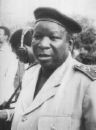
Ali Saibou

Ali Saibou

Will Tandja agree? I would be surprised. He’s shown a remarkable unwavering drive to remain in power at all costs, and there are clearly now powerful family and military cliques who are using Tandja as cover for their enrichment — or to simply stave off prosecutions which might follow a change of government.

The last Nigerien strongman, Ibrahim Baré Maïnassara, was overthrown in similar circumstances.

The last Nigerien strongman, Ibrahim Baré Maïnassara, was overthrown in similar circumstances.

On the other hand, Tandja might be wise to follow in the footsteps of Ali Saibou. Saibou retired to his home village in 1993, and to the best of my knowledge is still there. The next Nigerien strongman to be removed from power, Colonel / General / President Ibrahim Baré Maïnassara left the presidency in two body bags following a 1999 coup. Tandja might be reminded that the murder of that president took place only days after a then Nigerian President, Abubacar Abdulsalami, led ECOWAS negotiators in meetings with Baré Maïnassara over his annulment of promised elections. And the coup leaders who put Baré Maïnassara in power and took him out remain in places of influence in Tandja’s clique as well.

2 Comments Post a Comment
  1. [...] Yar’Adua’s government has kept an unusual concentration of pressure on Niamey. [see Niger:Piling on the Pressure for details] Sadly, this has far exceeded any pressure the remarkably unified internal opposition [...]

  2. [...] Yar’Adua’s government has kept an unusual concentration of pressure on Niamey. [see Niger:Piling on the Pressure for details] Sadly, this has far exceeded any pressure the remarkably unified internal opposition [...]

Leave a Reply


Past Features

  • “Unrequested fission surplus”: Kent Brockman, meet Jay Lehr
    15 March 2011 | 5:33 pm

      With the miserable news from Japan taking a turn towards a science-fiction level of horror, I’m afraid I can’t get Mr. Burns of the Simpsons out of my head. In one episode, as his nuclear plant goes critical, Mr Burns is giving a phone interview to a local newscaster Kent Brockman, and happily lying [...]

  • Niger: Lucky Seven. Can a new president signal more responsive politics in Niamey?
    11 March 2011 | 3:02 pm

    Saturday the 12th of March will see second round voting in Niger’s Presidential elections, marking a return to civilian rule and the beginning of the Seventh Republic.  It seems certain that front runner and PNDS-Tarayya candidate Mahamadou Issoufou will become the first President of the new republic on 8 April when the military junta that [...]

  • An Echo of New York’s Unfinished Struggles: A. Philip Randolph, Frank Crosswaith and the Socialist Party
    4 March 2011 | 3:14 pm

    Here’s a fascinating new article on the history of Harlem activists A. Philip Randolph and Frank R. Crosswaith, and their involvement with the Socialist Party (riven by right and left factionalism) in the 1920s. It places them in contrast to Black Nationalism, but highlights the abuse they were willing to put up with at the [...]

  • Libya’s “African Mercenary” Problem
    20 February 2011 | 11:07 pm

    As I write this, Saif Gaddafi is speaking to a Libyan people who have seemed to have already moved past his father’s regime.  His late and desperate attempt to scare his countrymen into rejecting a revolution which has engulfed his nation touched one element with which, seemingly, those opposing him might agree.  He blamed “crimes” [...]

  • Niger’s Presidential Elections are Underway
    1 February 2011 | 5:09 pm

    The 31st of January saw Niger’s Legislative elections, combined with the first round of the Presidential elections. Results are not yet known, and the top two in the Presidential race will re-run on 14 March. Here’s some tools to follow it. The best immediate updates on the polls and count can be found at the [...]

  • A Cairo Revolution
    29 January 2011 | 7:07 pm

    Marching in Imbaba, Cairo, originally uploaded by RamyRaoof. One overlooked media revelations from the Arab Revolutions of 2011 is the amount of material released with reusable copyright. Ramy Raoof in Cairo is releasing his work with a CC Attribution license, meaning popular media, as well as outlets like Wikipedia, have access to images of these [...]

  • Shock! South Africa WC not a tourist killing orgy.
    17 June 2010 | 4:29 pm

    As I’ll be spending most of this month tied to a TV or radio, I’ve so far noted one shocking fact: The South African World Cup is not riven by crime, corruption, shoddy workmanship, or terrorism. In fact, things are going swimmingly, the stadiums operations and infrastructure are beautiful, and the only deaths among the [...]

  • Niger, Mali: Hunger, famine or both
    27 May 2010 | 7:23 pm

    Hopefully by now everyone knows that parts of West Africa, especially pockets of Chad and Niger, are struggling with the worst food shortages since 2005. Alex Thurston reports that international humanitarian agencies, as well as increasingly concerned governments, are now worried that this crisis is more generalized than first reported (last September), striking areas of [...]

  • Niger: Innovative reforms amid famine
    25 May 2010 | 4:14 pm

    From 2005: “Drought has turned farmland into useless dirt…” Image via Wikipedia An unsigned editorial from Le Pays (Ouagadougou): A quite good reflection on the educational and other restrictions coming for future governments in Niger, but tying the famine. The papers in Niamey have little mention of the small farmers and herders Tahoua, Tillaberi, Diffa, [...]

  • Niger: Another kidnap in the north
    22 April 2010 | 3:22 pm

    The French press is reporting that a French tourist and an Algerian guide were kidnapped by armed men today in northern Niger, near the well at In-Abangaret. Also spelled Inabangaret, it's a stopping place on the Azzouagh plain's Tahoua/Assamakka/Tamanrasset road. This puts it relatively near the attack of several months ago on the Tahoua/Tillia road, and within reach of the band that carried out the attack on a Tillaberi army post last month. They were traced as far as the hills of west of Tin-Essako in Mali's northern Gao Region. While In-Abangaret doesn't come up in the news much, it is an important seasonal gathering point for some Tuareg communities (there is a "In-Abangaret Cross" in the famed Tuareg armorial tradition), as well as being in the midst a Berabiche transhumance zone. A hand grenade attack on Algerian truckers there in 1997 caused concern, with former members of one of the Arab rebel factions blamed for running a protection racket against long haul transport.

  • AQIM: More hostage stories
    20 April 2010 | 7:33 pm

    Philomène Kaboré and her husband Sergio Cicala have given interviews regarding their captivity: she having been released some time ago, and he Friday the 16th. They were taken in Mauritania, near the border with Mali, on...

  • Mali: Creeping famine in the north
    5 April 2010 | 3:35 pm

    Issikta blog republishes an urgent appeal from the mayors of Adielhoc and Tinzawaten communes in Kidal Region, northeast Mali. In a land where seasonally migrating animal herds are the economic foundation, there are reports of %40 of herds starving for...

  • Music: Early Ambassadeurs du Motel with Salif Keita
    22 March 2010 | 1:25 pm

    The Worldservice blog features tracks by Salif Keita & Les Ambassadeurs du Motel, from the first years after he left the Rail Band. I never knew there were such hard feelings. He quotes Salif Keita: "With the Rail Band I learned nothing, we only played what we heard. Les Ambassadeurs were more experienced: we weren't playing modernised folklore. Les Elephants Noirs were intellectuals. Arriving at the group I signed an apprenticeship contract to study music. We really played all kinds of music. We were like a real family, I really felt more at ease with Les Ambassadeurs. We rehearsed and studied the songs from 10 a.m. to 2 p.m. and played them the same evening."

    As always, the Dutch DJ behind "WrldServ" provides background you'll find few other places, as well as rare tracks, and in this case, rarer video. Check it out.

  • AQIM: Reports of the travels of the Tiloa attackers
    17 March 2010 | 10:11 pm

    Jeune Afrique reports sightings of the AQIM men who attacked the Nigerien army post at Tiloa, in the far north of Tillaberi last week. Apparently the Army knew there was a chance of attack somewhere in the area, having asked for reinforcements two days...

  • Togo: the political class fails its people, again.
    15 March 2010 | 3:01 pm

    Jeune Afrique editor François Soudan has a biting new piece on the recent Togolese election. Noting defeated opposition candidate Jean-Pierre Fabre’s neologism “Africaneries” (for “African Inherited rule”, presumably) Soudan turns the tables of blame deftly. “For African oppositions, some of whom, in Guinea and Niger, have been reduced to military coups to break political deadlocks [...]

  • Niger: Who’s in and out in the Regions?
    13 March 2010 | 1:58 am

    As I noted on the 10th of March, the CSRD junta in Niger has replaced all the civilian Region Governors with military men to administer local affairs during the transition. We now have the full list, and while I for one hate to see any military governing, a careful look at the men (all men) coming and going in Niger's Regions gives us an opportunity to examine what's going on behind the scenes, and what it augurs for the future. More ...

  • Niger: Did the coup sink the AREVA deal? No.
    11 March 2010 | 12:02 pm

    I.S. Gaoh of LE TEMOIN argues that the just announced scaling back of Areva's Imouraren mine schedule shows that backers of the coup (Hama Amadou?) were part of an agreement that AREVA would get a better uranium deal if Tandja was overthrown. This is built on the false assumption that what Tandja said about his deal was accurate, that it was some sort of hardball defense of Niger's interests (a portion of the ore to be sold on the market by Niger, more Nigerien staff). When in fact, the real hardball was likely more cash upfront to Tandja, on top of the 1.2 billion Euros upfront announced. Since the details are not public, we'll never know, unless the CSRD releases them, as they are unlikely to do. This would embarrass Areva (ergo, the French government) and likely mean Niger would have to repay the money Tandja took.

    Gaoh then says that the junta must break the deal now, and go after China or other neocolonial patrons to break France's grip before the next (corrupt) government.

  • Togo: Oppostion promises “popular uprising”
    8 March 2010 | 3:46 pm

    The headlines from Lome, Togo are tension inducing. For Togolese or those with family there, it must be excruciating. It appears that President and dictator's son Fauré Gnassingbé has been elected, while the main opposition leader vowed struggle: “We will launch a popular uprising until victory is ours.” More ...

  • Niger: Even good coups get the blues
    6 March 2010 | 12:22 am

    Nigeriens were - are - undoubtedly pleased that the army stepped in to end a newly installed dictatorship. But criticisms of this so called "good coup" are beginning to appear even amongst its strongest supporters. With many months of transitional rule ahead, these whispers give us some idea of the problems the junta will soon face.

  • African Cup Final ’56
    2 March 2010 | 10:33 pm

    One doesn't see much film, let alone color film, of colonial era African football. So you can imagine my delight when I stumbled across clips of a French colonial propaganda newsreel featuring the my favorite African club side wining a colonial cup final from 1956.

  • RSSArchive for Past Features »